Product update: October 22, 2026. Added to the News archive October 30, 2026.
The document that arrives three days later
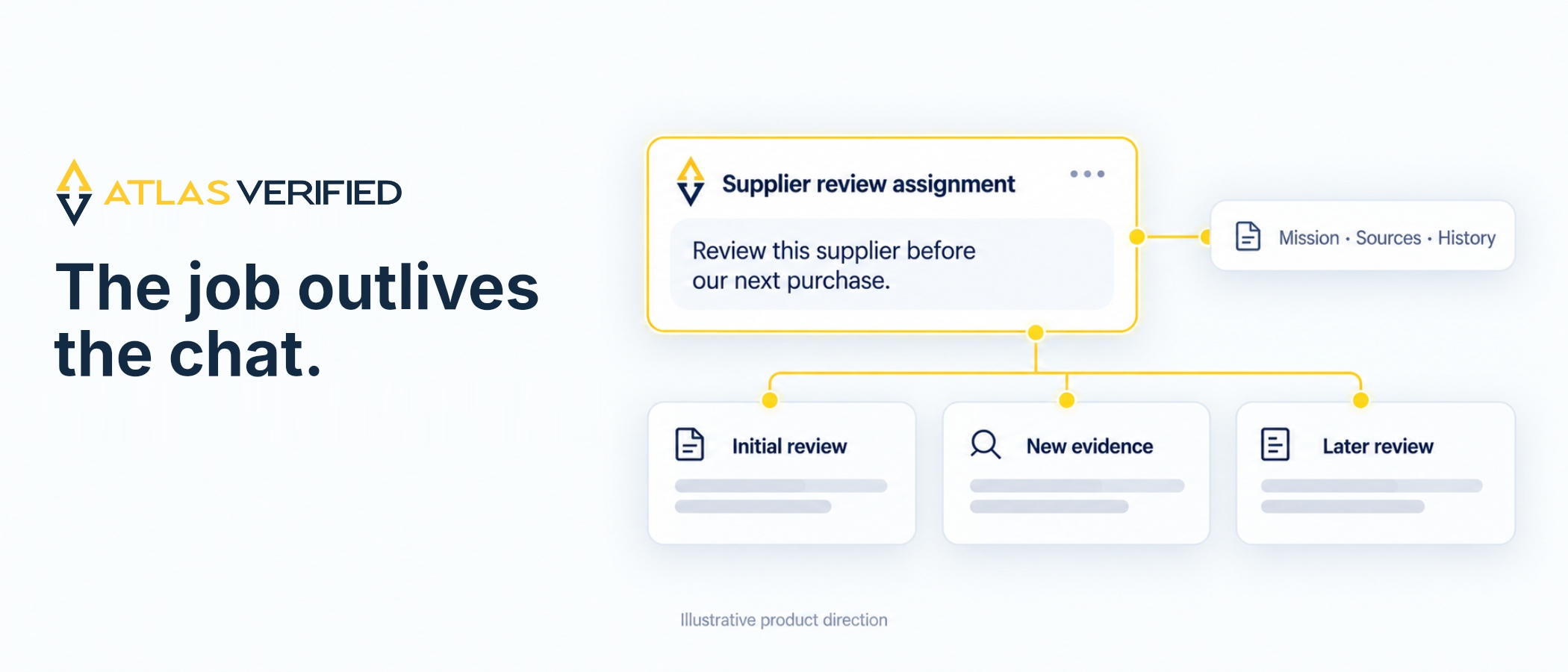
A supplier review does not end when the first assessment is written. A replacement certificate may arrive three days later. Someone has to recognize which review it belongs to, compare it with the earlier evidence, determine what changed, and bring the right person back into the decision. By then, the original conversation may be buried beneath a dozen other requests. The team still owns the responsibility, even though the interaction that began it is over.
That is the kind of continuity we are building Cloud Employees to support. The useful task is larger than reviewing one file. It may be keeping track of the evidence for a supplier assessment, preparing a recurring shipment exception report, or carrying a research assignment through several rounds of new information. Each requires the system to understand what remains in progress and why the next event matters.
A chat can already remember context, call tools, and start scheduled work. Our focus is how those capabilities come together around an ongoing responsibility: a defined job, access appropriate to that job, a history of the work, and an outcome someone can review. That is the product we mean when we talk about an AI employee.
Give the responsibility a place to live
Consider an assignment to keep a supplier review current. Before an employee can do useful work, the organization needs to define what “current” means. Which supplier and documents are in scope? What changes should prompt another assessment? What should the employee produce, and who will review it? A clear assignment gives the system a way to judge whether another run is useful and gives the manager a way to evaluate the result.
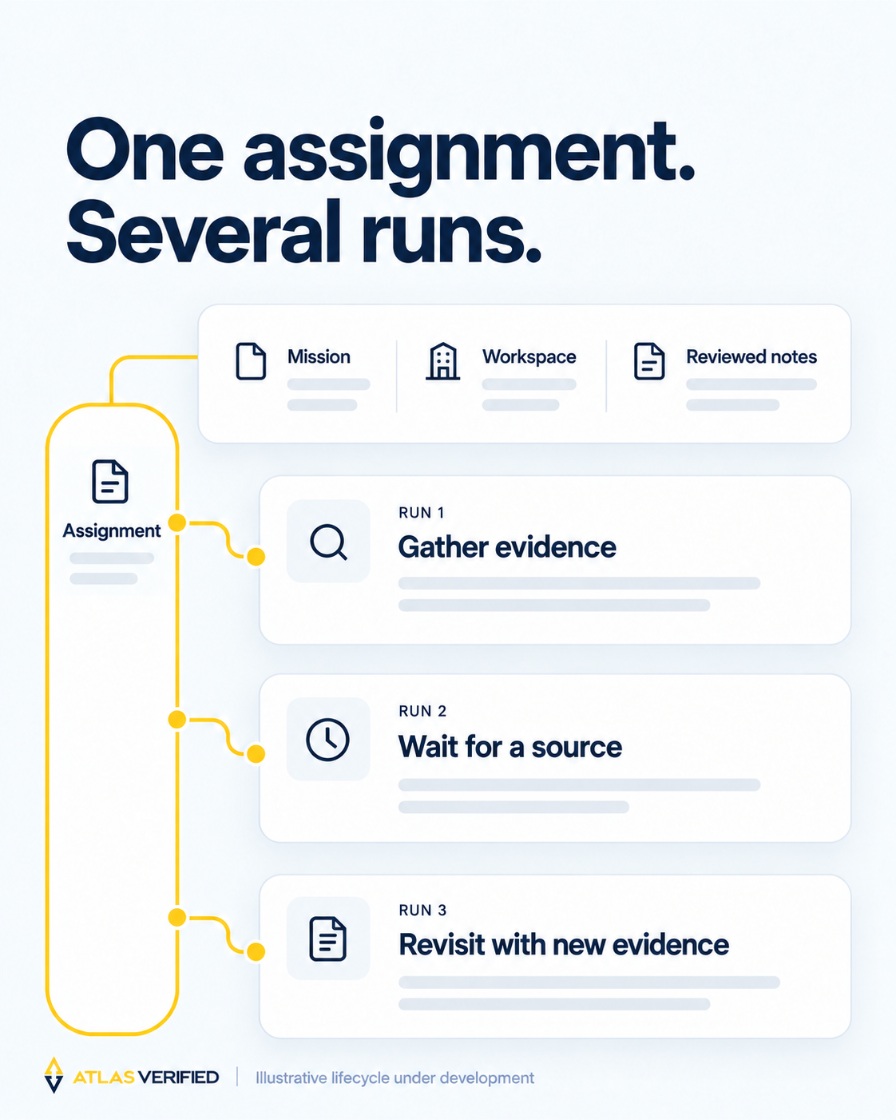
Atlas already has implemented foundations for that structure: employee identity and mission settings, operating intervals, budgets, approval modes, a durable operator conversation, and a document workspace. There are also structures for organizational context and memory, histories of runs and related work, and controls over tools and connectors. These provide places to keep the purpose, sources, and boundaries of the job.
The context needs distinctions of its own. A certificate is source evidence; an instruction defines the assignment; a reviewed note may capture a decision about how to interpret a relationship. Saving them all in a long conversation does not make them equally reliable or equally current. The employee should be able to carry relevant knowledge forward while leaving a person able to inspect and correct it. When the replacement certificate arrives, an old summary should not silently overrule the new source.
One assignment can outlive many runs
The job and its execution attempts have different lifetimes. One run may gather documents and produce a draft. Another may stop because a source is unavailable. A later run may have new evidence to consider. Treating each as an isolated task forces the system to reconstruct the assignment repeatedly; treating the previous answer as settled truth risks carrying a mistake forward. Continuity requires a more explicit account of what was completed, what remains open, and what has changed.
In the supplier example, a new certificate should lead to the parts of the assessment it affects. A reviewer’s correction to an entity relationship should remain available for the next investigation, with its scope understood. Unrelated completed work should not disappear merely because the plan changes. We are developing the assignment lifecycle around those requirements so the manager can see the state of the responsibility without reading every tool call or rebuilding the history from memory.
This is also where the idea of learning needs precision. Retaining an approved reporting format or a reviewed correction can make a later assignment more useful. That is different from automatically retraining the underlying model. Our direction is to turn reviewed outcomes into inspectable context, with a way to correct what is retained and decide where it applies. The quality of that context matters more than the amount of history accumulated.
The moment the employee has to stop
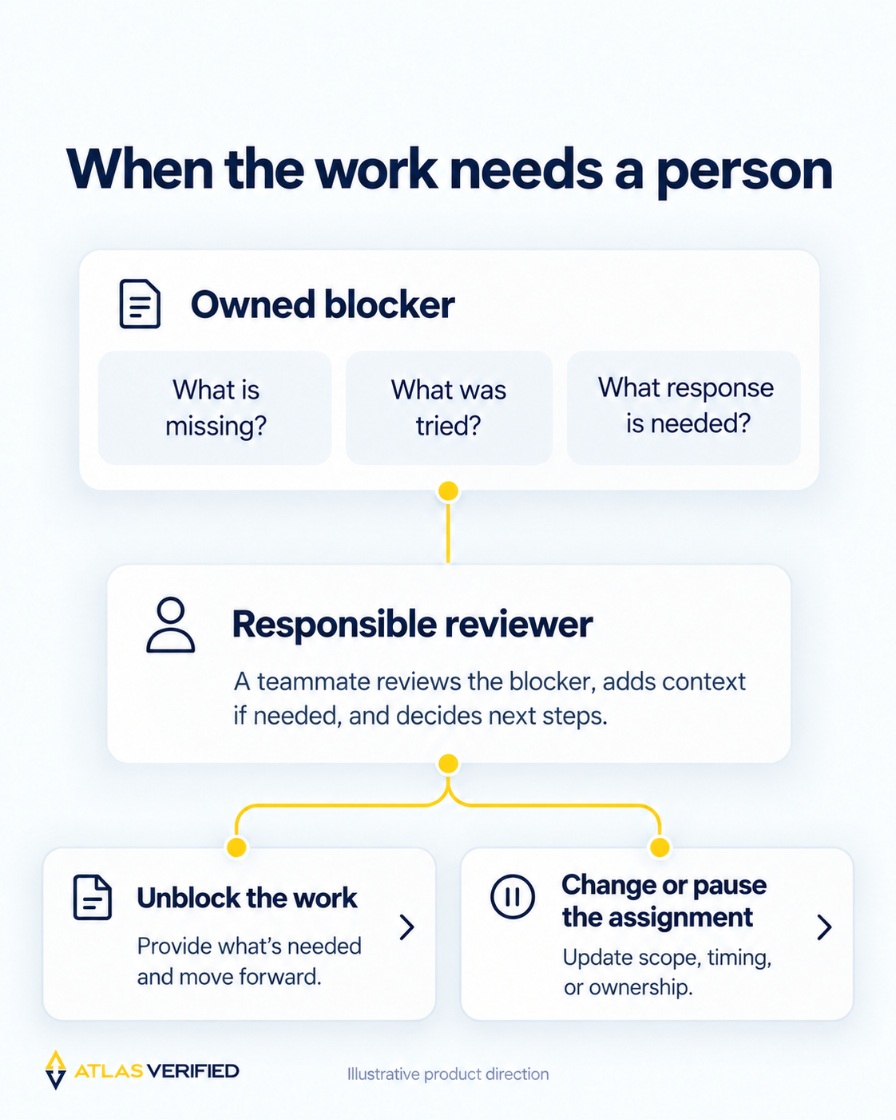
An ongoing responsibility will eventually encounter a decision outside its scope. The missing item may require a supplier to respond, a manager to approve an action, or an administrator to restore a connector. At that point, another round of model reasoning may not move the work forward. The employee needs to make the obstacle understandable and preserve the work while it waits.
We are building toward escalations that explain what is missing, what has already been attempted, why progress depends on a person, and what response would unblock it. A manager should be able to provide that response, change the assignment, or pause it without losing the history. Connecting the decision back to the correct assignment is part of the lifecycle; a notification on its own does not provide that continuity.
Authority has to be established before the employee reaches that moment. Access to read a supplier packet does not grant permission to change its records or contact another company. Atlas’s tool and connector controls, approval settings, and budgets give us foundations for defining those boundaries. The goal is an employee whose remit is understandable to its manager, including the actions that remain subject to review. Ongoing work should remain within an authorized purpose even when the model can imagine several other useful things to do.
The job ends with an outcome someone can inspect
The last step is easy to underestimate. An employee can generate a report and still fail to put it where the intended person can read it. It can describe an action without establishing that the action succeeded. It can finish a processing run while the underlying assessment remains unresolved. For the organization, those are different outcomes, and a dependable employee needs to preserve the difference.
We are treating delivery and outcome verification as part of the assignment. A report needs to exist and be accessible to its reviewer. An authorized action in another system needs evidence of the result. A blocker needs to remain visible if it prevents completion. The history should connect the original request to the attempts, sources, review decisions, and final artifact, giving the person managing the work a clear account of what happened.
The foundations for employee context, workspaces, scheduling, and access controls are implemented. The complete assignment-to-outcome lifecycle—including dependable delivery, owned blockers, and learning from reviewed work—is still under development and validation. Available capabilities depend on the workflow and rollout. We want to establish that reliability through bounded responsibilities with recognizable outputs and a person who can judge their quality, then expand from evidence about what works.
Return to the certificate that arrived three days after the original review. The ambition is that it reaches an assignment that still has a purpose, relevant context, and a responsible reviewer. The employee can carry the work forward because the job did not vanish when the conversation ended.