
Product update: October 15, 2026. Added to the News archive October 30, 2026.
Inside the thirty-minute run
On October 12, Atlas processed a supplier packet containing 47 documents and newly evaluated 2,539 selected questions. The run finished in 30 minutes and 29 seconds and saved an assessment. None of those selected answers had been carried over from an earlier run. The estimated model-processing cost was $11.22.
The significance is in the kind of work that becomes practical at that cost. A supplier packet contains names, dates, claims, relationships, and supporting statements that need to be understood together. A summary can make the packet shorter to read. A structured investigation can ask what each part establishes, how it relates to the supplier under review, and which conclusions still need evidence or validation.
That is what we are building into the updated Atlas supplier record. The run did not clear the supplier or conclusively settle every question. It gave us a measurable example of a much larger set of evaluations being performed within one working session—and a concrete record of the work that remained. The economics make that deeper examination possible. The product has to make its results useful.
Why a packet becomes weeks of work
Supplier verification tends to expand as it proceeds. A company name on one document prompts a check against another. A certificate describes a facility, while the transaction involves a related legal entity. A date changes which version of a document applies. An answer that looked straightforward at the beginning becomes conditional on a file that has not yet arrived. The reviewer is doing more than reading: they are maintaining a growing set of relationships and unresolved questions.
The elapsed process can stretch over days or weeks because those questions move through people and systems. Someone requests a document, another person reviews it, and the next question waits for the first response. Some of that time will remain outside the control of AI. A supplier still has to provide missing evidence, and a responsible person still has to make the decision. But the examination of material already in hand can happen earlier and in greater depth.
That is the opportunity we care about. If the first pass can organize thousands of focused checks and make their dependencies visible, the team can spend its attention on the questions that need judgment or follow-through. The work becomes easier to manage because its unresolved parts are explicit.
Thousands of small decisions, one larger investigation
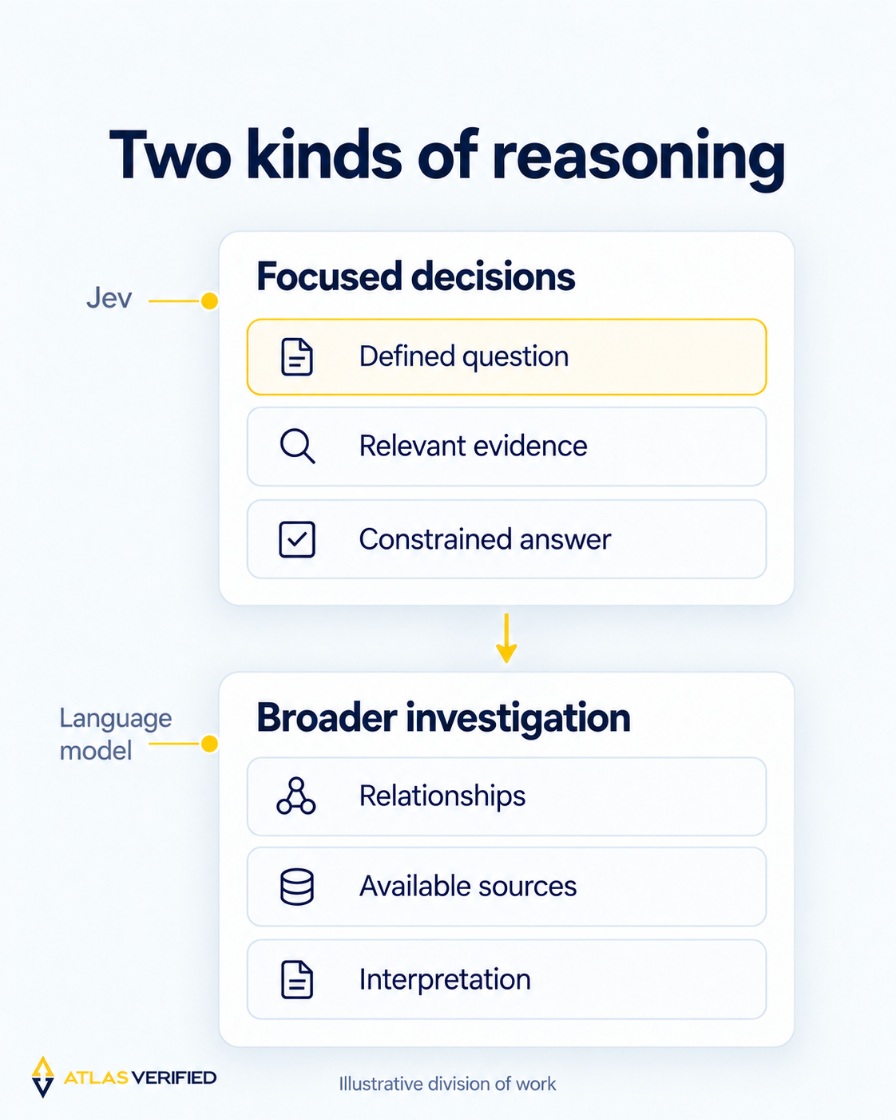
We are separating two kinds of reasoning that are often compressed into a single instruction to a large model. The first is a focused decision against relevant evidence: does this document name the entity being reviewed, does a stated date support the claim, or is the available text sufficient to answer the question? These decisions benefit from constrained choices and defined inputs. The second is the broader investigation: understanding why an answer matters, comparing it with other results, consulting available sources, and deciding what to examine next.
The current work uses Jev for focused decision tasks alongside a broader language-model investigation. In the October run, the recorded Jev charges were about $0.16; the broader model work accounted for approximately $11.05 in estimated usage. The division is instructive. Evaluating a large number of narrow questions can be a small part of the processing bill, leaving the more expensive reasoning for work that requires context and interpretation.
This is also why our strategy extends beyond one model provider. We want to be able to compare decision models on the specific questions they are asked, the evidence they receive, and the review required afterward. Other providers may become appropriate; an Atlas-fine-tuned open-weights decision model is another direction we intend to explore. The lasting asset is the investigation around the model: question definitions, evidence relationships, validation requirements, and the record of what happened. Those should survive a change in the component evaluating an individual question.
Integration means keeping the decision connected to its evidence
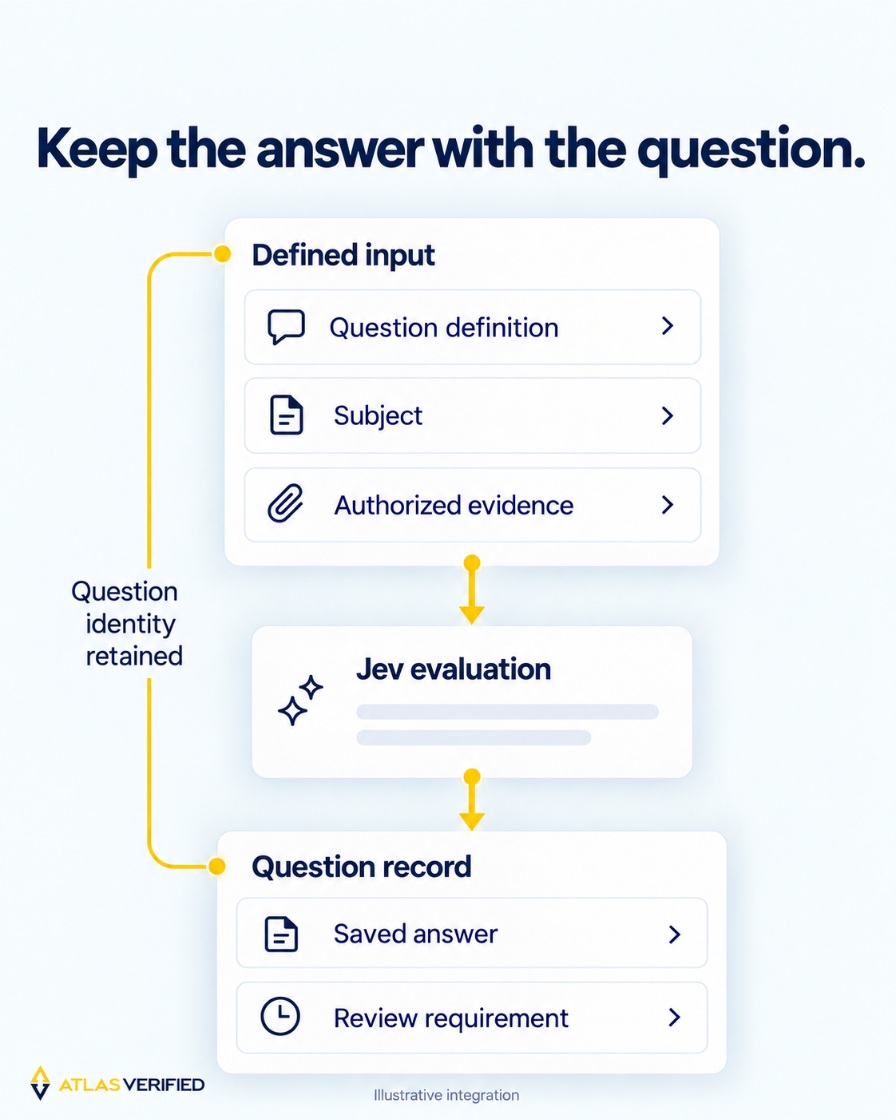
Integrating Jev into Atlas means more than sending a question to another model. A focused evaluation has a subject, a question definition, criteria, and the particular evidence it is allowed to use. Atlas retains those relationships through the request and back into the verification record, so the returned answer can be understood as part of the investigation.
Even when several questions share source material, their inputs remain distinct. The transport can avoid repeating the same evidence bytes while retaining each question’s authorized evidence and its own logical receipt. The answer then returns to the question record, where validation requirements and any required review remain visible.
That connection is what makes a specialized decision model useful in a larger workflow. The supplier record can show which question was evaluated, what evidence supported it, and what still needs review. Our model-testing work uses saved question inputs to examine alternatives without treating a previous model verdict as the answer key.
The supplier record has to show its work
A useful result cannot disappear into a paragraph saying that a supplier looks acceptable or needs further review. A person needs to understand which question produced a finding and what supports the answer. The updated supplier record brings those parts closer together. Document-level evaluations and supplier-wide questions can contribute to the assessment while retaining the distinctions needed to inspect them.
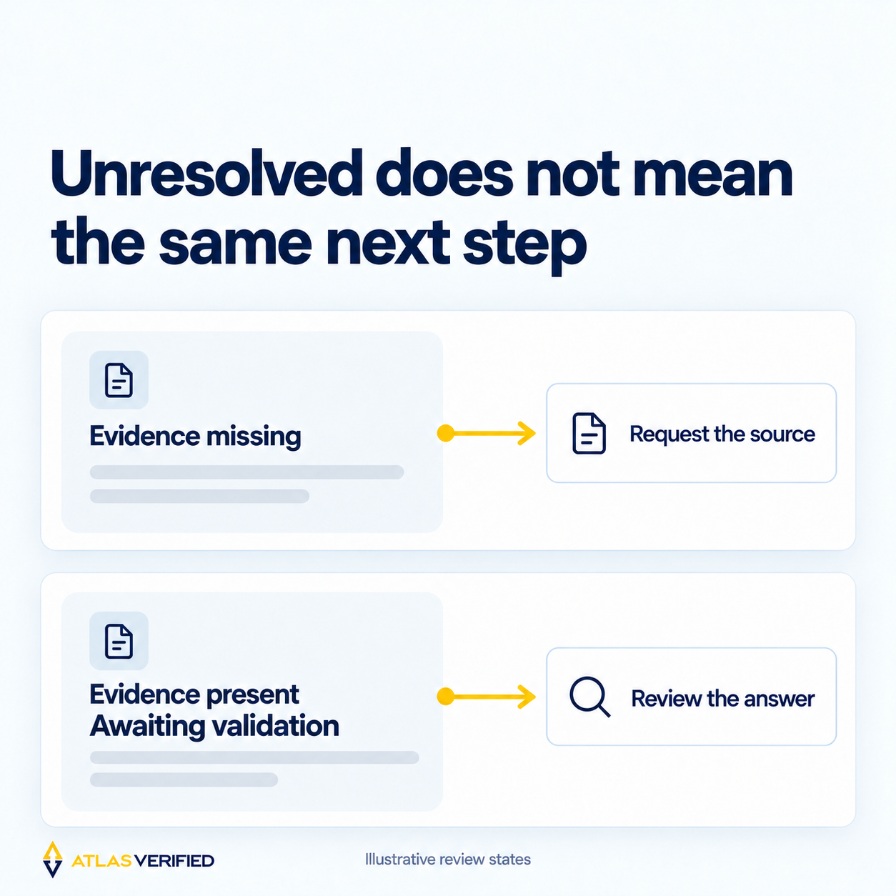
Consider two questions that both remain unresolved. One lacks the document needed to answer it. The other already has relevant source evidence, but its answer requires another level of validation. They may look similar in a high-level count, yet they require different next steps. The first calls for more evidence; the second calls for review. Sending another document request in both cases wastes time and makes the process harder for everyone involved.
Entity relationships need the same care. A document about a related company may be relevant without proving a claim about the supplier being assessed. A name mismatch can warrant investigation without establishing fraud. Keeping the subject entity, related entities, source material, and answer status distinct makes it possible for a reviewer to follow the reasoning rather than accept the final wording on trust. That is the product value of preserving the questions, not just the assessment they help produce.
What was complete when the run finished
The processing run completed; the supplier assessment remained unresolved. Of the 2,539 selected questions, one answer was validated as an adverse finding, while 2,538 remained provisional or had insufficient evidence. That is an answer-level result, not an adverse judgment about the supplier as a whole. It also does not mean the packet was missing 2,538 pieces of evidence: some answers awaited validation even where the relevant source material was present.
These distinctions are central to how we interpret the test. We have not established accuracy against a human-labelled set of correct answers, and the run created no new follow-up question records. It demonstrated large-scale evaluation and a saved assessment, while leaving correctness measurement and the recursive investigation loop as separate work. Calling every completed computation a completed investigation would obscure precisely the work the supplier record is supposed to expose.
The $11.22 figure is also a scoped processing estimate. It combines recorded Jev charges with estimated broader-model usage and excludes earlier rescans, unreported failed-call usage, separately charged tools, and regional premiums. It is not a customer price or an all-in cost of verification. Within that scope, it gives us a useful basis for examining how computation can be allocated between focused decisions and the broader investigation.
Spend the cost savings on depth
As model costs fall, we see an opportunity to ask more of the evidence. A lower processing bill is valuable, but it becomes more consequential if it lets a team examine relationships that would otherwise receive little attention. The ambition is a deeper first investigation and a clearer account of the questions worth pursuing afterward.
The next development step is a feedback loop between the two reasoning layers. A broader investigation should be able to identify a new question, gather the relevant evidence where available, send it for focused evaluation, and use the result to determine the next step. The October run did not validate that loop. We are treating it, along with better evidence coverage and reviewed correctness measurements, as work that needs its own proof.
Our goal is to increase checking depth by an order of magnitude while bringing latency and cost down. That is a development target, not a result we have already measured. The approach may extend beyond suppliers to shipment and inventory investigations, where many of the same problems recur: documents refer to records, records refer to other entities, and a conclusion depends on understanding the relationships.
The thirty-minute run gives us a starting point for that work. It shows why the economics of supplier investigation deserve another look, and why the supplier record must become a place where people can inspect the investigation as it develops.